The magnetic field $\vec{B}$ can be written as the curl of a helper field $\vec{A}$, called the magnetic vector potential. Many different $\vec{A}$ give the same $\vec{B}$ — this freedom is called gauge freedom. Ampère law then gives a fast way to read off $\vec{B}$ whenever the geometry has symmetry (straight wire, solenoid, toroid).
Reading the determinant. Expanding term by term gives the components: $B_x = \partial_y A_z - \partial_z A_y$, $;B_y = \partial_z A_x - \partial_x A_z$, $;B_z = \partial_x A_y - \partial_y A_x$.
Solenoid field via Ampère’s law
A solenoid is a long coil of $N$ turns over length $l$ ($n = N/l$ turns per metre). Inside, the field is uniform and parallel to the axis; outside an ideal long solenoid it is nearly zero.
- Draw a rectangular Amperian loop with one long side inside the solenoid (parallel to the axis) and the opposite side far outside where $B \approx 0$.
- Only the inside side contributes: $\oint\vec{B}\cdot d\vec{l} = B\,L$, where $L$ is the side length (reason: $\vec{B}\perp d\vec{l}$ on the short ends, $B \approx 0$ on the outside side).
- Enclosed current: the loop cuts $nL$ turns, each carrying $I$, so $I_{in} = nLI$.
- Ampère's law: $B\,L = \mu_0 n L I$, giving $B = \mu_0 n I$. The $L$ cancels — the field does not depend on where the loop sits, so it is uniform.
Solved PYQs
Q120182022×2
What is magnetic vector potential? (2018 adds three numerics: given $\vec{A}$, calculate $\vec{B}$.)
Recall
Steps
- Define $\vec{A}$ as the field whose curl equals $\vec{B}$; unit T·m. Many $\vec{A}$ give the same $\vec{B}$ (gauge freedom).
- Write components: $B_x = \partial_y A_z - \partial_z A_y$, $B_y = \partial_z A_x - \partial_x A_z$, $B_z = \partial_x A_y - \partial_y A_x$.
- Case 1 (2018): $\vec{A} = x^2\hat{i}$ only, so $A_x = x^2$, $A_y = A_z = 0$.
- Apply to Case 1: $B_y = \partial_z(x^2) - 0 = 0$, $B_z = 0 - \partial_y(x^2) = 0$, $B_x = 0 - 0 = 0$.
- Case 2 (2018): $\vec{A} = (x^2+y^2+z^2)\hat{i}$, so $A_x = x^2+y^2+z^2$, $A_y = A_z = 0$.
- Apply to Case 2: $B_x = 0$, $B_y = \partial_z A_x = 2z$, $B_z = -\partial_y A_x = -2y$.
- Case 3 (2018): $\vec{A} = x^2yz\,\hat{i} + xy^2z\,\hat{j} + xyz^2\,\hat{k}$ — all three components nonzero.
- Apply to Case 3: $B_x = \partial_y(xyz^2) - \partial_z(xy^2z) = xz^2 - xy^2$; $B_y = \partial_z(x^2yz) - \partial_x(xyz^2) = x^2y - yz^2$; $B_z = \partial_x(xy^2z) - \partial_y(x^2yz) = y^2z - x^2z$.
- At $(1,2,3)$: $B_x = 1\cdot 9 - 1\cdot 4 = 5$; $B_y = 1\cdot 2 - 2\cdot 9 = -16$; $B_z = 4\cdot 3 - 1\cdot 3 = 9$.
Answer
Exam tip
Q2201820192023×3
State Ampère's circuital law; mathematical form / show $\nabla\times\vec{B} = \mu_0\vec{J}$.
Recall
Steps
- Statement: $\oint\vec{B}\cdot d\vec{l} = \mu_0 I_{in}$ — line integral of $\vec{B}$ round any closed loop equals $\mu_0$ times the enclosed current.
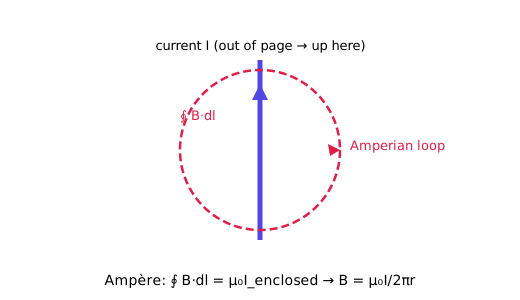
- Proof for a long wire: take an Amperian circle of radius $r$ around it. $B = \mu_0 I/2\pi r$ is tangent to the circle and constant on it.
- Integrate: $\oint\vec{B}\cdot d\vec{l} = B(2\pi r) = \mu_0 I$. By superposition this holds for any loop shape and any set of steady currents.
- Get the differential form: by Stokes' theorem $\oint\vec{B}\cdot d\vec{l} = \int(\nabla\times\vec{B})\cdot d\vec{S}$ and $I_{in} = \int\vec{J}\cdot d\vec{S}$.
- Since the surface is arbitrary, the integrands must match: $\nabla\times\vec{B} = \mu_0\vec{J}$.
Answer
Exam tip
Q32022
What is the meaning of $\nabla\cdot\vec{B} = 0$? Using Biot–Savart law prove $\nabla\cdot\vec{B} = 0$.
Recall
Steps
- State the meaning in three points: (a) no magnetic monopoles — field lines never start or end; (b) lines close on themselves (circles round currents); (c) net flux through any closed surface is zero, $\oint\vec{B}\cdot d\vec{S} = 0$.
- Biot–Savart integrand is a curl: write $d\vec{l}\times\hat{r}/r^2$ as the curl (with respect to the field point) of $d\vec{l}/r$.
- Hence the total $\vec{B}$ equals $\nabla\times\vec{A}$ for some vector potential $\vec{A}$ (the vector potential from Q1).
- Apply the identity: divergence of any curl is identically zero, $\nabla\cdot(\nabla\times\vec{A}) = 0$, because mixed partials cancel ($\partial_x\partial_y = \partial_y\partial_x$).
Answer
Exam tip
Reference. Brij Lal & Subrahmanyam Ch-7, 8; H.C. Verma Vol-1 Ch-35; S.L. Arora Vol-1 Ch-4.