This page covers superposition of two collinear SHMs. It has three short theory sections, two figures, and six solved PYQs.
1. Same frequency → resultant amplitude and phase
Superposition principle. When two waves overlap, the resultant displacement at any instant is the algebraic sum of the two separate displacements: $y = y_1 + y_2$. This works because each SHM obeys a linear differential equation ($\ddot{y} + \omega^2 y = 0$) — sums of solutions are also solutions. Without linearity there would be no clean "resultant SHM".
Two vibrations along the same line with the same frequency join into one vibration. Like two people pushing a swing together: the pushes add.
For $y_1 = a_1\sin\omega t$ and $y_2 = a_2\sin(\omega t+\phi)$, the result is $y = A\sin(\omega t+\theta)$ with
Derivation in one line
Expand $y_2 = a_2\sin\omega t\cos\phi + a_2\cos\omega t\sin\phi$. Collect $\sin\omega t$ and $\cos\omega t$ terms, then match with $A\sin(\omega t+\theta) = A\sin\omega t\cos\theta + A\cos\omega t\sin\theta$. Compare coefficients, square and add to eliminate $\theta$: gives $A^2$. Divide to get $\tan\theta$.
Special cases
- $\phi = 0$: $A = a_1 + a_2$ (loudest).
- $\phi = \pi$: $A = |a_1-a_2|$ (quietest).
- $\phi = \pi/2$, equal $a$: $A = a\sqrt{2}$.
2. Different frequencies → beats + mine-gas use
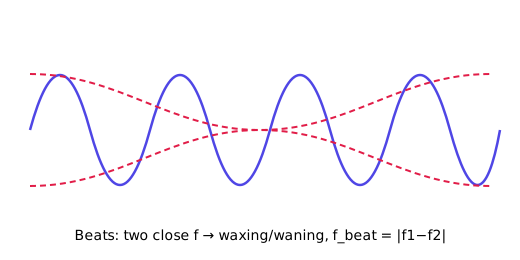
Two nearly equal frequencies go in and out of step. Sound gets loud, then soft, then loud again. Each loud-soft cycle is one beat. Like two fans nearly in sync: the hum swells and fades.
For equal amplitudes $y_1 = a\sin\omega_1 t$, $y_2 = a\sin\omega_2 t$, the sum-to-product identity gives
$$y = 2a\cos!\left(\frac{\Delta\omega,t}{2}\right)\sin(\bar{\omega}t)$$
where $\bar{\omega} = (\omega_1+\omega_2)/2$ is the fast carrier and $\Delta\omega = \omega_1-\omega_2$ is the slow envelope. The amplitude $2a\cos(\Delta\omega t/2)$ swells to $2a$ and sinks to $0$. Intensity $\propto (\text{amplitude})^2$ peaks twice per envelope cycle, so
Mine-gas detector (2022)
A reference tuning fork sounds with a resonator filled with mine air. Clean air gives no beats. Poisonous gas changes the air density, which shifts the resonator frequency by a tiny amount. Even a 1–2 Hz shift gives audible beats. So beats detect gas before instruments show it (the ear hears $|f_1-f_2|$ easily).
3. Sonometer frequency law
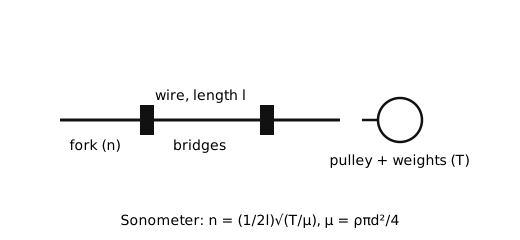
A stretched string sings higher when pulled tighter, shorter, thinner, or lighter. One formula joins all four effects.
Ratio form
Drop constants ($\pi/4$ and $1/2$ cancel in ratios): $n \propto \sqrt{T}/(l,d\sqrt{\rho})$. For two strings: $\dfrac{n_1}{n_2} = \dfrac{l_2}{l_1}\sqrt{\dfrac{T_1}{T_2}}\dfrac{d_2}{d_1}\sqrt{\dfrac{\rho_2}{\rho_1}}$.
Solved PYQs
Find the resultant amplitude and phase due to superposition of $y_1 = 3\sin(50\pi t)$ cm and $y_2 = \sqrt{3}\cos(50\pi t)$ cm.
20192023×2 Recall- $y_2 = \sqrt{3}\cos(50\pi t) = \sqrt{3}\sin(50\pi t + \pi/2)$ (reason: $\cos x = \sin(x+\pi/2)$, so $\phi = \pi/2$).
- $A^2 = 3^2 + (\sqrt{3})^2 + 2(3)(\sqrt{3})\cos(\pi/2) = 9 + 3 + 0 = 12$ (reason: $\cos 90° = 0$ kills the cross term).
- $A = \sqrt{12} = 2\sqrt{3} \approx 3.46$ cm.
- $\tan\theta = (\sqrt{3}\sin 90°)/(3 + \sqrt{3}\cos 90°) = \sqrt{3}/3 = 1/\sqrt{3}$, so $\theta = 30°$ (first quadrant, both numerator and denominator positive).
What are beats? How are they applied in the determination of poisonous gases in mines?
2022 Recall- Define beats: periodic loud-soft pattern from superposition of two close frequencies (reason: Eq. 2 above).
- State the beat formula $f_{\text{beat}} = |f_1 - f_2|$ per second.
- Mine use: a reference tuning fork drives a resonator filled with mine air (reason: density of air sets the resonator frequency).
- Poisonous gas changes the air density, shifts the resonator frequency by a small amount, and the ear hears $|f_1-f_2|$ beats even at 1–2 Hz shift (reason: ear resolves beat rate, not absolute pitch).
Sonometer numerical: tensions in ratio $8:1$, lengths $36:35$, diameters $4:1$, densities $1:2$; higher pitch $360$ Hz. Find beats produced.
2023 Recall- $n_1/n_2 = (l_2/l_1)\sqrt{T_1/T_2}\,(d_2/d_1)\sqrt{\rho_2/\rho_1}$ (reason: ratio form of Formula 3).
- $l_2/l_1 = 35/36$ (reason: invert $36:35$), $\sqrt{T_1/T_2} = \sqrt{8} = 2\sqrt{2}$, $d_2/d_1 = 1/4$, $\sqrt{\rho_2/\rho_1} = \sqrt{2}$.
- Multiply: $n_1/n_2 = (35/36)\times 2\sqrt{2}\times(1/4)\times\sqrt{2} = (35/36)\times(2\times 2/4) = (35/36)\times 1 = 35/36$ (reason: $\sqrt{2}\times\sqrt{2} = 2$).
- $n_1/n_2 < 1$, so $n_2$ is higher; $n_2 = 360$ Hz and $n_1 = 360\times 35/36 = 10\times 35 = 350$ Hz (reason: $360/36 = 10$).
- Beats $= |360 - 350| = 10$ per second.
What are beats? Give the theory of beats.
20192022×2 Recall- Define beats: when two sound waves of slightly different frequencies superpose, the intensity waxes and wanes periodically — each wax-wane cycle is one beat (reason: §2 above).
- Write $y_1 = a\sin\omega_1 t$, $y_2 = a\sin\omega_2 t$ and add by the superposition principle (reason: resultant displacement is the algebraic sum).
- Apply sum-to-product: $y = 2a\cos(\Delta\omega t/2)\sin(\bar{\omega}t)$ with $\bar{\omega} = (\omega_1+\omega_2)/2$, $\Delta\omega = \omega_1-\omega_2$ (reason: trig identity).
- Read off: fast carrier $\sin(\bar{\omega}t)$ (the heard pitch) inside a slow envelope $2a\cos(\Delta\omega t/2)$ (reason: $\Delta\omega \ll \bar{\omega}$).
- Intensity $\propto$ (amplitude)$^2$ peaks twice per envelope cycle, so beat rate $f_{\text{beat}} = |f_1 - f_2|$ per second (reason: $\cos^2$ has half the period of $\cos$).
Two waves $y_1 = 3\sin(\omega t)$ and $y_2 = 4\sin(\omega t + \pi/6)$ superpose each other. What will be the amplitude of the resultant wave?
2023 Recall- Identify $a_1 = 3$, $a_2 = 4$, phase gap $\phi = \pi/6$ (reason: both are sine form with the same $\omega t$).
- $A^2 = 3^2 + 4^2 + 2(3)(4)\cos 30° = 9 + 16 + 24\times(\sqrt{3}/2)$ (reason: Formula 1).
- $A^2 = 25 + 12\sqrt{3} \approx 25 + 20.78 = 45.78$ (reason: $\sqrt{3} \approx 1.732$).
- $A = \sqrt{45.78} \approx 6.77$.
Two S.H.Ms of same frequency along the same line have amplitudes in the ratio $3:4$. If the phase difference between them is $45°$, find the ratio of the amplitude of the resultant S.H.M. to that of the smaller of the two.
2024 Recall- Write $a_1 = 3k$, $a_2 = 4k$ (reason: ratio $3:4$; $k$ cancels in the final ratio).
- $A^2 = (3k)^2 + (4k)^2 + 2(3k)(4k)\cos 45° = 9k^2 + 16k^2 + 24k^2/\sqrt{2}$ (reason: Formula 1).
- $24/\sqrt{2} = 12\sqrt{2}$, so $A^2 = k^2(25 + 12\sqrt{2})$ (reason: rationalize).
- $A = k\sqrt{25 + 12\sqrt{2}} \approx k\sqrt{41.97} \approx 6.48k$ (reason: $12\sqrt{2} \approx 16.97$).
- Required ratio $= A/(3k) = \sqrt{25+12\sqrt{2}}/3 \approx 6.48/3 \approx 2.16$.
Reference. Subrahmanyam & Brij Lal — Waves & Oscillations Ch-4 (superposition, beats, sonometer).