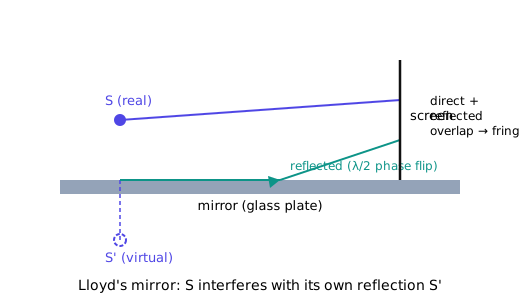
A slit sits just above a flat glass mirror. Light reaches the screen two ways — straight from the slit, and bounced off the mirror. The bounced beam looks as if it comes from a mirror-image slit below the glass. The two beams interfere. Daily example: your reflection in a shop window overlapping with you.
Here $S$ = real slit (height $h$ above the mirror), $S’$ = virtual image ($h$ below the mirror plane), so $d = 2h$. $D$ = distance from the source plane to the screen.
How it works
Step 1 — Setup. A narrow slit $S$ is placed a small height $h$ above a polished glass plate (the mirror), with the slit parallel to the plate surface. A screen stands vertically at distance $D$, its lower edge nearly touching the mirror.
Step 2 — Two beams. Beam 1 goes directly from $S$ to the screen. Beam 2 reflects off the glass and then reaches the screen. Tracing beam 2 backward, it appears to come from $S’$, the mirror image of $S$ at depth $h$ below the plate — so $d = SS’ = 2h$.
Step 3 — Coherence. Both beams come from the same slit $S$, so the phase difference is fixed — division of wavefront, like the biprism.
Step 4 — The Stokes flip. Reflection at the glass (rarer→denser) flips the phase by $\pi$, i.e. adds $\lambda/2$ to the reflected beam’s path. So where YDSE would give a bright centre, Lloyd’s mirror gives a DARK centre — the central fringe (at the mirror plane level) is dark.
Step 5 — Fringes. Path difference $\Delta = dy/D$ as usual, but with the extra $\lambda/2$: bright where $\Delta = (n-\tfrac12)\lambda$, dark where $\Delta = n\lambda$. Fringe width is unchanged: $\beta = \lambda D/d$.
Unit check: $[\lambda D/d] = L$ ✓. Limit: $h \to 0$ ($d \to 0$) gives $\beta \to \infty$ — slit touching the mirror, no fringes, sensible.
Trap: only HALF the usual YDSE field is visible — the mirror blocks the lower half, so fewer fringes are seen than with a biprism.
Lloyd’s mirror vs Fresnel biprism (exam table)
| Point | Lloyd’s mirror | Fresnel biprism |
|---|---|---|
| Second source | virtual image by REFLECTION ($S’$) | two virtual images by REFRACTION |
| Phase flip | yes — $\lambda/2$ on reflection, centre dark | no flip, centre bright |
| Fringes visible | half field (mirror blocks rest) | full overlap field |
| Extra use | proves the $\lambda/2$ Stokes flip directly | measures $d$ by displacement method |
Solved PYQs
Distinguish between Lloyd's mirror and Fresnel's biprism.
2022Recall
Steps
- Source pair: Lloyd's uses one real slit plus its mirror image (reflection); biprism uses two virtual images by refraction through thin prisms.
- Phase: the reflected beam in Lloyd's mirror suffers a $\pi$ ($\lambda/2$) flip at the glass — the biprism has no reflection, so no flip.
- Centre fringe: dark for Lloyd's (flip), bright for biprism (no flip).
- Field: Lloyd's shows fringes only above the mirror plane (half field); biprism shows the full overlap region.
- Write the 4-row table above — the table itself is the answer.
Answer
Exam tip
In Lloyd's mirror experiment, the real and virtual sources are $1$ mm apart and the screen is placed at a distance of $1$ m from the source. If the wavelength of light used is $5890$ Å, find the fringe width.
2022Recall
Steps
- Given: $d = 1$ mm $= 1.0\times 10^{-3}$ m; $D = 1$ m; $\lambda = 5890$ Å $= 5.89\times 10^{-7}$ m.
- Formula: $\beta = \lambda D/d$.
- Substitute: $\beta = (5.89\times 10^{-7}\times 1)/(1.0\times 10^{-3}) = 5.89\times 10^{-4}$ m.
- Convert: $5.89\times 10^{-4}$ m $= 0.589$ mm.
Answer
Exam tip
In Lloyd's mirror experiment, the real and virtual sources are $1.5$ mm apart and the screen is placed at a distance of $1.5$ m from the source. If the wavelength of light used is $5890$ Å, find the fringe width.
2023Recall
Steps
- Given: $d = 1.5\times 10^{-3}$ m; $D = 1.5$ m; $\lambda = 5.89\times 10^{-7}$ m.
- Ratio: $D/d = 1.5/(1.5\times 10^{-3}) = 1000$.
- $\beta = \lambda\times 1000 = 5.89\times 10^{-7}\times 10^3 = 5.89\times 10^{-4}$ m $= 0.589$ mm.
- Sense: identical to Q2 because $D/d$ is identical — the paper scaled both numbers by $1.5\times$.
Answer
Exam tip
In Lloyd's mirror experiment, the real and virtual sources are $1.2$ mm apart and the screen is placed at a distance of $1.2$ m from the source. If the wavelength of light used is $5890$ Å, find the fringe width.
2024Recall
Steps
- Given: $d = 1.2\times 10^{-3}$ m; $D = 1.2$ m; $\lambda = 5.89\times 10^{-7}$ m.
- $D/d = 1.2/(1.2\times 10^{-3}) = 1000$.
- $\beta = 5.89\times 10^{-7}\times 10^3 = 5.89\times 10^{-4}$ m $\approx 0.59$ mm.
Answer
Exam tip
Reference. Brij Lal, Subrahmanyam & Avadhanulu — Optics Ch-14 (Lloyd's mirror, Stokes flip); Ajoy Ghatak — Optics Ch-13.